OSI Model
It stands for Open System Interconnect model.
It’s an ISO standard for how computers communicate over a network.
Divides operations into 7 different layers, with each layer specific for an action. Each data segment is encapsulated from layer 7 to layer 1 by the sender, and deincapsulated from layer 1 to layer 7 by the receiver. Each layer is contained by the next layer.
Layer Number Layer Name Description 7 Application UPPER LAYERS 6 Presentation UPPER LAYERS 5 Session UPPER LAYERS 4 Transport Includes port number and TCP or UDP protocols 3 Network Includes IP Address and it’s operated by the router 2 Data Link Includes Ethernet MAC Address and it’s operated by the switch 1 Physical It’s the cable layer, of 1s and 0s
Benefits of the OSI Model
- Engineers can just focus on the layer they are interested in, instead of designing the whole connection
- It avoids conflicts with other vendors
- Troubleshooting gets easier because it is split in each layer
TCP/IP Suite
It was developed by the Department of Defense of the United States under the ARPA project.
It’s a protocol stack that includes multiple protocols like TCP and IP. It’s the main protocol stack used today.
The difference between TCP/IP and OSI is that TCP/IP is an actually used protocol stack to transfer data over a network, while the OSI model is just a reference model.
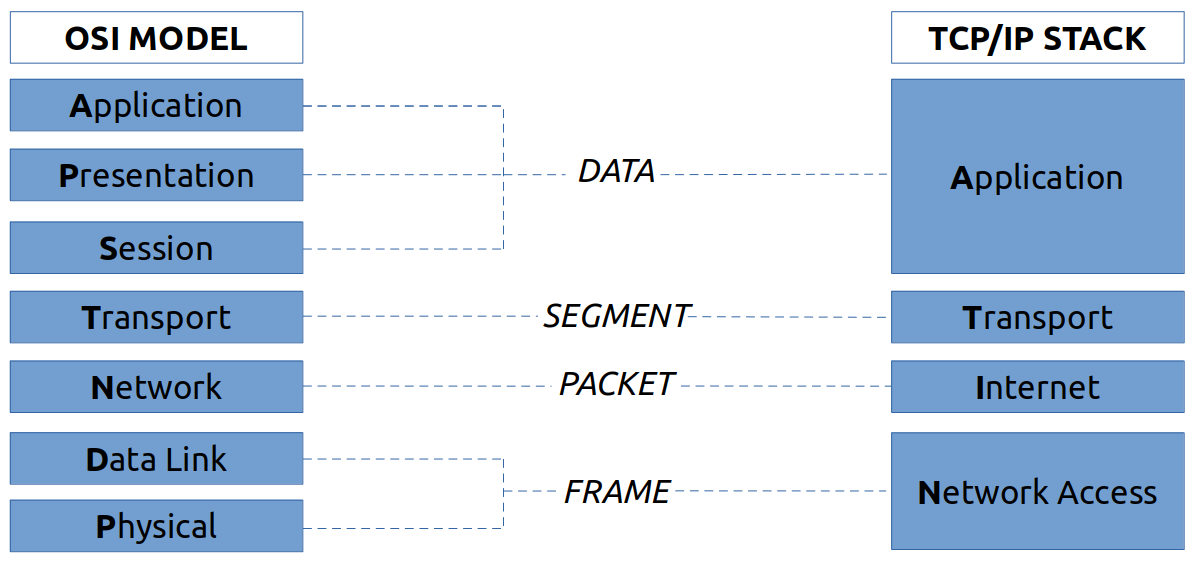
TCP/IP works with layers as the OSI model; they are fewer than OSI, but they are equivalent in functions and operations.
When two hosts talk to each other, they exchange PDUs (Protocol Data Unit). They can be divided into different terms based on which layer of the TCP/IP is considered (see picture 2.1).
SOMETIMES PDUs ARE REFERRED AS “PACKETS”, MEANING THE WHOLE HOST TO HOST COMMUNICATION DATA.